Financing & Incentives
HVAC rebates and incentives
Utility, manufacturer, federal, and local programs — and how to verify eligibility.
By Home Standard9 min read
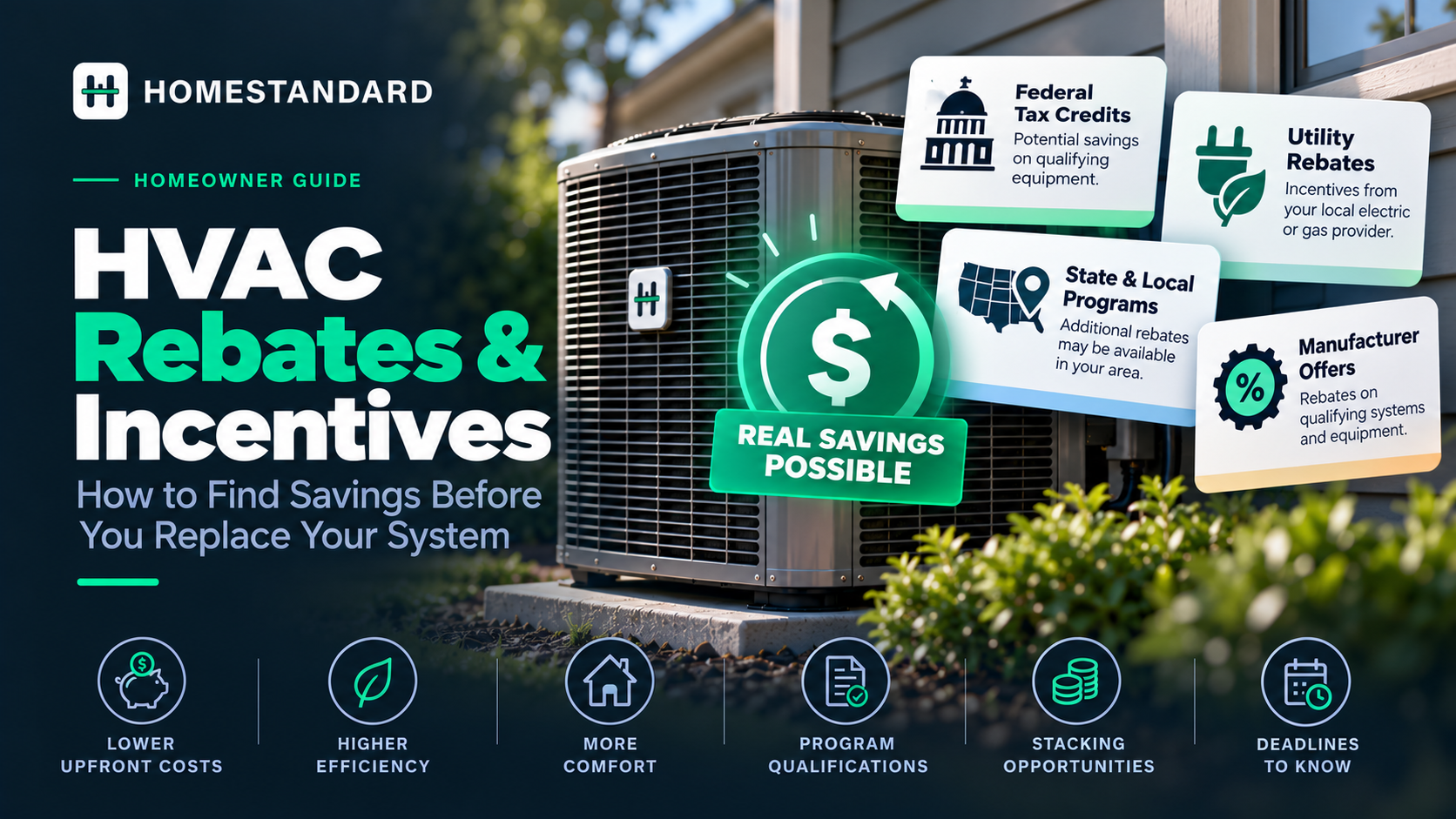
HVAC Rebates and Incentives: How to Find Savings Before You Replace Your System
Replacing an HVAC system can easily become one of the larger expenses you'll face as a homeowner.
Then, somewhere during the research process, you start seeing advertisements like:
“Get thousands back on a new heat pump.”
“Qualify for energy-efficiency rebates.”
“Federal incentives available.”
Suddenly, a $15,000 HVAC replacement sounds like it might cost substantially less.
Sometimes it can.
But HVAC incentives are also one of the easiest parts of the replacement process to misunderstand.
A rebate, tax credit, manufacturer promotion, and financing offer are four different things. Eligibility can depend on where you live, what equipment you purchase, your utility provider, household income, when the system is installed, and even the exact model number.
And programs change.
In fact, that's especially important right now: some federal HVAC tax credits that were available for equipment installed through December 31, 2025 are no longer available for new 2026 installations. IRS
So before you choose equipment because someone tells you it “qualifies for incentives,” here's what you should understand.
What Types of HVAC Incentives Are Available?
HVAC savings generally fall into several categories:
Type | Where It Comes From | How You May Receive It |
|---|---|---|
Federal tax incentives | Federal government | Tax credit |
State programs | State agencies | Varies |
Utility rebates | Electric or gas utility | Rebate or bill credit |
Local programs | City or regional organizations | Varies |
Manufacturer rebates | Equipment manufacturer | Rebate or promotional discount |
Contractor promotions | HVAC company | Discount or bundled offer |
Financing promotions | Lender/contractor | Reduced borrowing cost |
These programs can sometimes overlap.
But you shouldn't assume they're automatically stackable.
Each program has its own eligibility rules.
First: Understand the Difference Between a Rebate and a Tax Credit
These terms are frequently used interchangeably in HVAC advertising, but they're not the same thing.
HVAC Rebate
A rebate generally returns or reduces a qualifying amount associated with your purchase.
Depending on the program, the rebate might be applied at the point of sale or received later after documentation is submitted and approved.
For example, a utility might offer a rebate for installing a qualifying high-efficiency heat pump.
HVAC Tax Credit
A tax credit affects your tax liability.
It isn't necessarily an instant discount from your contractor.
For example, the federal Energy Efficient Home Improvement Credit previously allowed qualifying improvements installed from 2023 through 2025 to receive credits subject to specific limits. The IRS states that the credit is no longer available for improvements made after December 31, 2025. IRS
That distinction matters.
If someone tells you:
“You'll save $2,000 on this system.”
you should ask:
“Is that an immediate rebate, a tax credit, or something else?”
Be Careful With Outdated Federal HVAC Tax Credit Information
This deserves special attention because there's a large amount of outdated information online.
For qualifying installations through the end of 2025, the Energy Efficient Home Improvement Credit generally provided a credit equal to 30% of certain eligible expenses, subject to annual and equipment-specific limits. Qualifying heat pumps could receive up to $2,000, while certain central air conditioners, furnaces, boilers, and related property were subject to different limits. IRS
However, the IRS currently states that the credit applied to qualifying improvements made through December 31, 2025. IRS
So if you're purchasing HVAC equipment in 2026, don't rely on an article, contractor page, or advertisement written in 2024 or 2025 that tells you you'll automatically receive the old federal credit.
Always verify the current rules before including a tax incentive in your budget.
What About Federal Home Energy Rebates?
Separate from the former federal tax credit, the Department of Energy's Home Energy Rebates initiative includes two major programs:
HOMES — Home Owner Managing Energy Savings
and
HEEHR — High-Efficiency Electric Home Rebate
These programs are administered through participating states, territories, and Tribes rather than functioning as one identical nationwide rebate available everywhere.
The Department of Energy says Home Energy Rebates are currently available in select states, with eligibility and implementation depending on the individual program. Energy.gov
That means seeing a national headline such as:
“Homeowners can get up to $14,000!”
doesn't mean you personally have a $14,000 HVAC rebate waiting for you.
The maximum figures can involve multiple eligible improvements and specific household or program requirements.
You need to check the program available where you live.
Check the Department of Energy Home Energy Rebates program
Utility Rebates Can Be Especially Important
Your local electric or natural-gas utility may offer its own incentives.
Depending on the utility, these might apply to:
Heat pumps
High-efficiency air conditioners
Furnaces
Smart thermostats
Duct sealing
Insulation
Air sealing
Heat-pump water heaters
Home energy audits
These programs can be very location-specific.
Two homeowners living 30 miles apart may have access to completely different incentives because they're served by different utilities.
That's why your ZIP code and utility provider matter when estimating potential HVAC incentives.
Manufacturer Rebates Are Different Again
HVAC manufacturers periodically offer rebates or promotional programs on specific equipment.
For example, a manufacturer might offer an incentive when you purchase qualifying combinations of:
Outdoor equipment + furnace or air handler + thermostat
These promotions can sometimes make higher-tier equipment more financially attractive.
But manufacturer rebates may have:
Specific qualifying models
Purchase deadlines
Installation deadlines
Registration requirements
Participating-contractor requirements
Submission deadlines
If your contractor says a system includes a manufacturer rebate, ask for the details in writing.
Higher Efficiency Doesn't Automatically Mean a Bigger Net Savings
Suppose you're comparing two systems:
System A: $11,500
No applicable rebate
System B: $15,000
$1,500 rebate
After the rebate:
System B still costs $13,500.
The rebate didn't “save” you money compared with System A.
It reduced the cost of the more expensive system.
That might still be a worthwhile purchase if System B offers greater efficiency, comfort, warranty coverage, or other benefits.
But incentives shouldn't distract you from the underlying economics.
Compare:
Final net cost vs. final net cost.
Not:
System with rebate vs. system without rebate.
Don't Buy an Upgrade Just to Get the Rebate
This is one of the easiest traps to fall into.
Imagine:
Standard system: $12,000
Higher-efficiency system: $15,000
The higher-efficiency system qualifies for a $1,000 rebate.
It can be tempting to think:
“I'm saving $1,000.”
But you're still spending:
$2,000 more than the standard system.
That additional $2,000 may absolutely be worthwhile.
Perhaps the higher-efficiency system provides better humidity control, quieter operation, variable capacity, lower energy consumption, or a better warranty.
Just make that decision based on the net investment and benefits, not simply because a rebate exists.
Equipment Eligibility Can Be Very Specific
An HVAC system doesn't necessarily qualify for an incentive simply because it's described as “high efficiency.”
Programs may require specific:
SEER2 ratings
EER2 ratings
HSPF2 ratings
Equipment combinations
Product certifications
Model numbers
Installation requirements
For example, the former federal HVAC tax-credit rules required qualifying equipment to meet specified efficiency criteria; ENERGY STAR maintained lists and guidance for eligible equipment. ENERGY STAR
The same principle applies to current rebates.
Verify the exact equipment combination — not just the brand or product family.
Ask for the AHRI Certificate
When you're purchasing a matched HVAC system, you may hear contractors reference an AHRI certificate.
This documentation can help identify the certified performance of a specific combination of indoor and outdoor equipment.
That's important because HVAC efficiency ratings can depend on the combination being installed.
An outdoor unit advertised as capable of a certain SEER2 rating doesn't necessarily achieve that rating with every indoor coil, furnace, or air handler.
If an incentive depends on efficiency, ask the contractor to document that the specific system combination being installed satisfies the program's requirements.
Income-Qualified HVAC Rebates
Some programs provide different incentive amounts depending on household income.
That means two homeowners purchasing similar equipment could potentially qualify for different benefits.
The DOE's Home Energy Rebates programs, for example, include program structures where eligibility and available assistance can depend on household income and the rules adopted by the state, territory, or Tribe administering the program. Energy.gov
If a program mentions percentages of Area Median Income, don't assume you qualify or don't qualify based solely on your salary.
Household size and geographic area may affect the calculation.
Verify the program's actual requirements.
Can You Combine Multiple HVAC Incentives?
Sometimes.
A project might potentially involve some combination of:
Utility rebate + manufacturer rebate + state program + contractor promotion
But stacking rules vary.
One program may reduce the eligible project cost used to calculate another benefit.
The IRS, for example, noted under the former federal Energy Efficient Home Improvement Credit that certain subsidies, rebates, and incentives could affect the amount of qualified expenses used to calculate the credit. IRS
Never simply add every advertised incentive together and assume that's what you'll receive.
Instead, ask:
“Can these specific incentives be combined?”
When Do You Actually Receive the Money?
This is another important question.
An incentive might be:
Applied Immediately
The discount reduces what you owe at installation.
Received After Installation
You pay the full amount and submit documentation for reimbursement.
Applied to a Utility Account
The benefit may appear as a bill credit.
Claimed Later
Certain tax incentives are claimed when filing taxes rather than reducing today's invoice.
Those differences matter if you're financing the project.
Suppose your system costs $15,000 and you're expecting a $1,500 rebate three months later.
You may still initially finance the full $15,000.
Understand the cash flow before signing.
Who Is Responsible for Submitting the Rebate?
Never assume the contractor handles everything.
Depending on the program:
The contractor may submit it.
You may submit it.
Both of you may have documentation requirements.
Before installation, ask:
Who submits the application?
What documents are required?
What's the deadline?
When should I expect payment?
What happens if the application is rejected?
Keep copies of invoices, model numbers, certificates, rebate forms, and proof of installation.
Don't Treat an Unverified Incentive Like Guaranteed Money
Suppose a salesperson tells you:
“This qualifies for $3,000 in rebates.”
Before subtracting $3,000 from your mental purchase price, verify it.
Ask for:
The name of the program.
The organization providing the incentive.
The qualifying equipment requirements.
The expected incentive amount.
Any income requirements.
The program deadline.
Who submits the paperwork.
Whether funding is currently available.
There's a meaningful difference between:
“You definitely qualify.”
and
“You may qualify.”
Your budget should reflect that difference.
Watch the Expiration Dates
Many incentive programs have deadlines.
A promotion might require the system to be:
Purchased by one date
and
Installed by another date.
Funding-based programs can also change as funds are allocated.
Tax laws can change.
Utility programs can change.
Manufacturer promotions can expire.
That's why Home Standard shouldn't tell you that an incentive exists based solely on a static list created months ago.
Current availability should be verified when you're actually preparing to purchase.
Where Should You Look for HVAC Rebates?
A good incentive search should check several sources.
Start with:
Your electric utility
Your natural-gas utility
Your state's energy office
Relevant federal programs
Equipment manufacturers
Your HVAC contractor
ENERGY STAR also provides tools for locating efficiency incentives based on location. ENERGY STAR
Explore ENERGY STAR incentives and rebates
The Department of Energy also maintains information about home-energy rebates and available energy-saving programs. Energy.gov
Explore Department of Energy savings programs
How to Compare HVAC Systems After Incentives
Suppose you receive three proposals:
System A | System B | System C | |
|---|---|---|---|
Installed price | $11,500 | $14,000 | $17,000 |
Verified incentives | $0 | $1,000 | $2,000 |
Net estimated cost | $11,500 | $13,000 | $15,000 |
Efficiency | Standard | Higher | Highest |
Equipment type | Single-stage | Two-stage | Variable |
Warranty | Standard | Enhanced | Enhanced |
Now you're looking at something useful.
Instead of simply seeing:
“$2,000 rebate!”
you can ask whether spending an additional $3,500 over System A for System C makes sense based on the efficiency, comfort, features, warranty, and expected operating costs.
That's a much better decision.
Rebates Should Change the Math — Not Make the Decision
HVAC incentives can be valuable.
If you're already considering a qualifying system, a rebate could materially improve its economics.
In some cases, incentives could even make an equipment upgrade financially attractive that otherwise wouldn't be.
But the existence of a rebate doesn't automatically mean you should purchase the qualifying equipment.
Start with:
What does my home actually need?
Then determine:
What systems meet those needs?
Then:
What do those systems cost?
And finally:
Which verified incentives reduce those costs?
That keeps the decision centered on your home rather than the promotion.
Know Your Incentives Before You Sit Down With a Contractor
Imagine being presented with a $16,000 HVAC system and hearing:
“Don't worry — there are rebates available.”
If you've never researched the programs, you have no easy way to know whether the number is accurate, whether you qualify, or whether another system could produce better value.
That's why incentive research belongs before the purchasing decision whenever possible.
Knowing what's potentially available gives you a baseline.
Then you can evaluate the contractor's recommendations rather than relying entirely on them.
Know What the Numbers Say Before You Buy
The real cost of an HVAC replacement isn't always the number at the top of the proposal.
It's closer to:
Installed price − verified incentives + financing costs = your effective cost
And even that number should be considered alongside operating costs, efficiency, comfort, warranty coverage, and expected ownership.
Home Standard helps homeowners understand those numbers before making a major HVAC decision.
Get a personalized analysis of your current system, replacement readiness, expected replacement cost range, repair economics, efficiency opportunities, and potential incentives worth investigating.
Free. About two minutes. No obligation.
Before you spend $10,000+ on a new HVAC system, know what the numbers say.
[Get My Free HVAC Analysis →]
Keep reading
- Financing & Incentives
How HVAC financing works
Monthly payments, total cost, promotional rates, and the questions to ask a lender.
Read - Repair vs. Replace
Should I repair or replace my HVAC system?
Age alone does not decide it. How repair cost, recurring issues, and comfort fit together.
Read - HVAC Costs
How much does HVAC replacement cost?
What goes into a replacement price, and why ranges are more honest than single numbers.
Read