HVAC Costs
How much does HVAC replacement cost?
What goes into a replacement price, and why ranges are more honest than single numbers.
By Home Standard8 min read
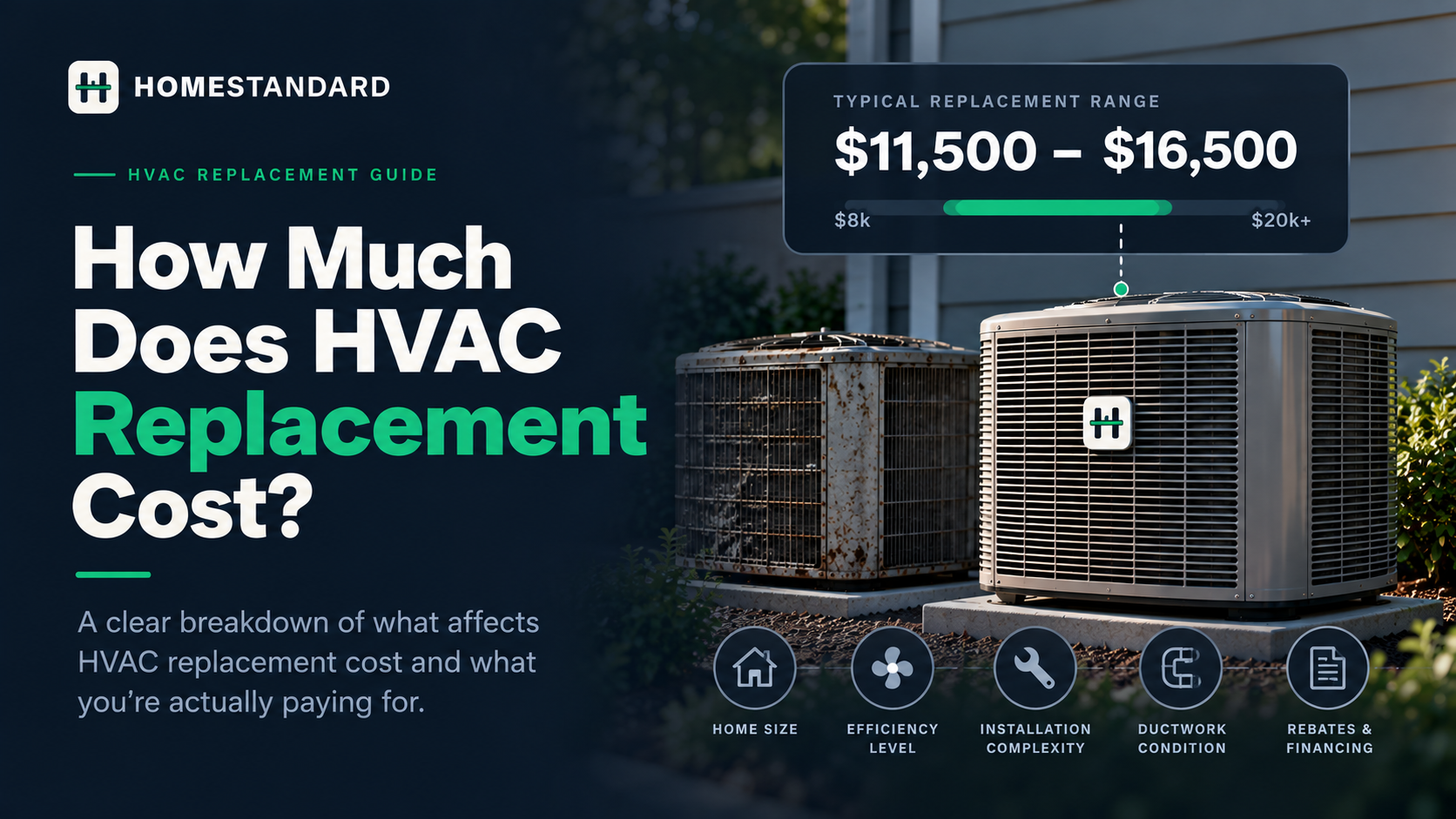
How Much Does HVAC Replacement Cost? A Homeowner’s Guide to What You’re Actually Paying For
Replacing an HVAC system is one of the larger expenses homeowners eventually face. Unfortunately, figuring out what a replacement should cost isn’t as simple as looking up the price of a furnace or air conditioner online.
You might see one company advertising a complete system for $7,000 while another quotes $15,000 or more.
So what gives?
The equipment itself is only part of the cost. Your home’s size, system type, efficiency level, ductwork, installation requirements, electrical work, permits, warranties, and even where the equipment is located can significantly affect the final price.
That’s why the better question isn’t simply:
“How much does a new HVAC system cost?”
It’s:
“What should an HVAC replacement cost for my home?”
Here’s what homeowners should understand before comparing quotes.
How Much Does a New HVAC System Cost?
For many homeowners, a complete HVAC replacement can cost somewhere in the several-thousand to tens-of-thousands-of-dollars range.
That’s intentionally broad.
A straightforward replacement of basic equipment in a smaller home is very different from installing a high-efficiency variable-capacity system with duct modifications, electrical upgrades, zoning, or indoor air-quality equipment.
A typical replacement may include some combination of:
Replacement | What It May Include |
|---|---|
Air conditioner only | Outdoor condenser, indoor coil, refrigerant-related work |
Furnace only | Furnace and necessary venting or installation modifications |
AC + furnace | Complete heating and cooling system |
Heat pump system | Outdoor heat pump and compatible indoor equipment |
Dual-fuel system | Heat pump combined with a gas furnace |
Ductless system | One or more outdoor and indoor units |
Instead of assuming there is one “normal” price, it’s more useful to understand why one home may require a significantly different investment than another.
1. The Size of Your Home — and Your HVAC System
Larger homes generally require more heating and cooling capacity, but square footage alone shouldn’t determine system size.
A contractor should consider factors such as:
Square footage and ceiling height
Number and size of windows
Insulation levels
Air leakage
Home orientation and sun exposure
Local climate
Number of occupants
Ductwork
Construction materials
This information can be used to perform a heating and cooling load calculation.
Installing a larger system simply because “bigger is better” can actually create problems.
An oversized air conditioner may cool the home quickly but shut down before adequately removing humidity. Frequent short cycling can also increase wear on components.
An undersized system may run excessively and struggle to maintain comfortable temperatures.
Proper sizing matters just as much as the equipment you purchase.
2. Equipment Efficiency Can Significantly Affect Price
HVAC systems are available at different efficiency levels.
Higher-efficiency equipment generally costs more upfront but may use less energy during operation.
For air conditioners and heat pumps, efficiency is commonly represented using SEER2 ratings. Furnaces typically use AFUE.
But higher efficiency does not automatically mean a particular system is the best financial choice for every homeowner.
Suppose one system costs several thousand dollars more but produces relatively modest utility savings in your particular home.
The higher-efficiency system may provide other benefits, but the energy savings alone could take many years to recover the additional upfront cost.
That’s why homeowners should consider both:
Upfront investment + expected operating cost
rather than comparing efficiency ratings alone.
3. Single-Stage vs. Two-Stage vs. Variable-Capacity Equipment
Two HVAC systems with similar efficiency ratings can still have dramatically different prices.
One reason is how they operate.
Single-Stage Systems
A traditional single-stage system essentially operates at full capacity whenever it's running.
These systems are usually less expensive and mechanically simpler.
Two-Stage Systems
Two-stage equipment can operate at a lower capacity during milder conditions and increase output when additional heating or cooling is needed.
This can improve temperature consistency and humidity control.
Variable-Capacity Systems
Variable-capacity systems can adjust their output across a much wider operating range.
Instead of repeatedly turning on at full capacity and shutting off, they may operate for longer periods at lower output.
These systems can provide excellent comfort and humidity control, but the equipment and controls generally cost more.
The best option depends on what you're trying to accomplish.
Someone primarily concerned with replacing a failed system at the lowest reasonable cost may make a different decision than someone who wants better humidity control, quieter operation, and more consistent temperatures.
4. Installation Difficulty Matters More Than Most Homeowners Realize
Two identical HVAC systems can have different installation prices depending on the homes they're being installed in.
Consider the difference between equipment located in:
An open basement
A small utility closet
A crawlspace
An attic
A finished mechanical room
Installation conditions can affect the amount of labor required.
Your project may also require modifications to:
Refrigerant lines
Gas piping
Venting
Electrical circuits
Condensate drainage
Equipment platforms
Flue systems
Supply or return transitions
That's why comparing equipment model numbers alone doesn't necessarily tell you whether two quotes are equivalent.
5. Your Ductwork Could Affect the Replacement Cost
Your new HVAC equipment depends on your duct system to move conditioned air throughout the house.
If the ductwork is poorly designed, undersized, leaking, or damaged, installing new equipment won't necessarily fix your comfort problems.
You could still experience:
Hot and cold rooms
Excessive noise
Weak airflow
High static pressure
Long equipment runtimes
Poor humidity control
Some installations require only minor duct modifications around the new equipment.
Others may benefit from larger return ducts, redesigned transitions, additional supply runs, or more extensive duct replacement.
Those improvements increase the project cost, but they may also address problems that replacing the equipment alone cannot solve.
6. Additional Components Can Change the Price
An HVAC replacement quote may include considerably more than the furnace and air conditioner.
Depending on the home and system design, additional equipment could include:
Smart thermostat
Humidifier
Dehumidifier
Media air cleaner
Electronic air cleaner
UV equipment
Zoning controls
Surge protection
Condensate pumps
Equipment monitoring
Improved filtration
These aren't necessarily required for every installation.
Ask your contractor to clearly separate required work from optional upgrades so you understand exactly what you're paying for.
7. Labor and Installation Quality Are Part of the Price
It's tempting to think of HVAC replacement as purchasing a piece of equipment.
In reality, you're purchasing an installed mechanical system.
Installation quality can have a major effect on how well that system performs.
The installation process may involve properly:
Sizing the equipment
Setting airflow
Charging the refrigerant
Configuring controls
Installing drainage
Sealing duct connections
Commissioning the equipment
Testing system operation
A premium piece of equipment installed poorly may perform worse than less expensive equipment installed correctly.
When comparing quotes, don't look exclusively at the equipment brand and final price.
Ask what the contractor actually does during the installation and how they verify that the finished system is operating correctly.
8. Permits and Code Requirements Can Add to the Cost
Depending on where you live and the work being performed, HVAC replacement may require permits, inspections, electrical modifications, gas-line changes, or other code-related work.
Older homes can sometimes present additional complications.
For example, replacing equipment may uncover electrical, venting, drainage, or mechanical conditions that need to be corrected as part of the installation.
A detailed estimate should explain what is included so you aren't surprised by additional charges later.
9. Rebates and Incentives May Reduce Your Net Cost
Depending on the equipment, location, utility provider, and programs available when you purchase, certain HVAC systems may qualify for financial incentives.
These could potentially include:
Utility rebates
Manufacturer rebates
State or local programs
Federal tax incentives
Energy-efficiency programs
Eligibility requirements can be very specific.
Don't assume that every high-efficiency system automatically qualifies.
Before counting an incentive toward your budget, verify the current program requirements and confirm that the specific equipment and installation qualify.
10. Financing Can Change the Cost More Than You Think
Many homeowners finance HVAC replacements rather than paying the entire cost upfront.
That can make a replacement easier to manage, but it's important to distinguish between the purchase price and the total amount you will ultimately pay.
For example, financing may involve:
Interest
Dealer fees
Promotional periods
Deferred-interest provisions
Different loan terms
A low monthly payment doesn't necessarily mean a lower-cost system.
Ask to see both the cash price and financing terms whenever possible.
Then compare the total cost rather than evaluating the monthly payment alone.
Why Are HVAC Quotes So Different?
Imagine receiving three quotes:
Contractor A: $8,500
Contractor B: $12,000
Contractor C: $16,500
It's tempting to conclude that Contractor A is cheap and Contractor C is expensive.
But you don't actually know that yet.
Contractor A might be quoting basic equipment with minimal modifications.
Contractor B might include higher-efficiency equipment, improved filtration, duct corrections, permits, and a better labor warranty.
Contractor C might include premium variable-capacity equipment and substantial ductwork modifications.
Or all three contractors might be proposing nearly identical work at dramatically different prices.
The number alone doesn't tell you.
You need to compare what you're actually receiving.
What Should Be Included in an HVAC Replacement Quote?
Before signing a contract, make sure you understand the scope of work.
A good proposal should make it relatively easy to identify:
Item | What to Look For |
|---|---|
Equipment | Manufacturer, model or series, capacity |
Efficiency | SEER2, AFUE, or applicable ratings |
Labor | Installation work included |
Ductwork | Any modifications or repairs |
Electrical | Required electrical work |
Thermostat | Included model or compatibility |
Permits | Whether they're included |
Warranty | Parts and labor coverage |
Accessories | Filtration, IAQ, zoning, etc. |
Removal | Disposal of existing equipment |
Final price | Cash price and financing terms |
If you don't understand something in the proposal, ask.
You should know what you're buying before making a decision involving thousands of dollars.
Should You Get Multiple HVAC Quotes?
For a planned HVAC replacement, comparing multiple options can be valuable.
But don't simply ask:
“Who's cheapest?”
Instead, try to determine whether you're comparing equivalent installations.
One contractor may identify a ductwork problem another contractor missed. Another may recommend different equipment sizing. One proposal might include a 10-year labor warranty while another provides only one year.
Those differences matter.
The objective is to understand why the prices are different.
Beware of Focusing Only on the Monthly Payment
It's common to see HVAC systems marketed primarily through monthly payments.
“Get a new system for only $149 per month” sounds considerably easier to digest than a five-figure replacement price.
But the monthly payment doesn't tell you:
The actual system price
The interest rate
The loan term
The total interest paid
Whether financing fees were built into the price
A monthly payment can be useful for budgeting, but it shouldn't replace understanding the underlying numbers.
Ask for the complete financing terms before making your decision.
The Cheapest System Isn't Always the Least Expensive System
There's an important distinction between price and cost.
A less expensive installation could ultimately cost more if it results in high utility bills, repeated service calls, poor comfort, or premature equipment failure.
At the same time, the most expensive system isn't automatically the best investment.
You can also overspend on features or efficiency levels that provide little practical benefit for your home.
The goal is to find the point where equipment, installation quality, comfort, reliability, efficiency, and price make sense together.
How Can I Know What HVAC Replacement Should Cost for My House?
This is where generic online price guides become less useful.
Two houses on the same street can require different systems.
The homeowner next door may have:
Different square footage
Different insulation
Different ductwork
A different fuel source
Different comfort problems
Different equipment
Different installation requirements
So knowing that someone else paid $9,000 or $15,000 doesn't necessarily tell you what your project should cost.
And that's ultimately the problem with asking:
“What's the average HVAC replacement cost?”
An average describes everyone.
It doesn't describe your house.
Know the Numbers Before You Talk to a Contractor
HVAC replacement is difficult to evaluate when you don't know what a reasonable price looks like before someone is sitting at your kitchen table presenting options.
That's why doing some research beforehand can be valuable.
Before you replace your system, try to understand:
Your system's approximate age
Whether replacement is actually warranted
Your likely replacement cost range
Potential efficiency opportunities
Available incentives
Financing considerations
The questions you should ask a contractor
The more you understand beforehand, the easier it becomes to evaluate the recommendations you receive.
Find Out What HVAC Replacement Could Cost for Your Home
You don't need to become an HVAC expert just to understand whether a replacement quote makes sense.
Home Standard can help you establish a baseline before you talk to a contractor.
Complete our free HVAC analysis and receive a personalized report covering your system, expected replacement cost range, repair economics, efficiency opportunities, potential incentives, and other factors worth considering.
It's free, takes about two minutes, and there's no obligation.
Know what the numbers say before you spend $10,000+ on a new HVAC system.
Keep reading
- HVAC Costs
Why HVAC quotes vary so much
Capacity, efficiency, ductwork, electrical, and access can move a price by thousands.
Read - Repair vs. Replace
Should I repair or replace my HVAC system?
Age alone does not decide it. How repair cost, recurring issues, and comfort fit together.
Read - Heat Pumps
Heat pump vs. furnace
Climate, fuel costs, and existing equipment shape which system makes sense.
Read