Homeowner Guides
What to know before talking to a contractor
The details to gather and the questions to ask before an in-home evaluation.
By Home Standard10 min read
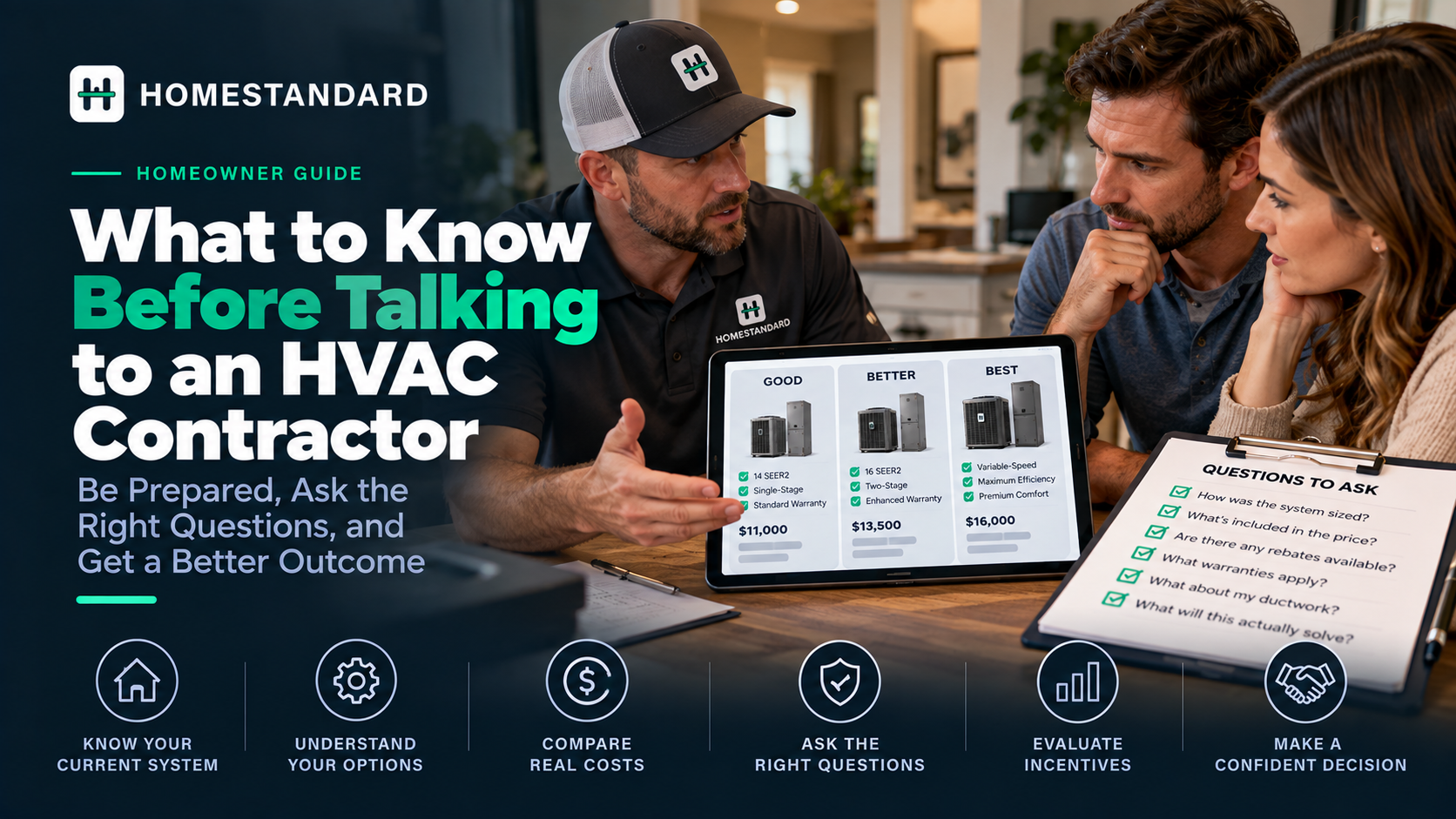
What to Know Before Talking to an HVAC Contractor
Your air conditioner is 14 years old.
It has needed two repairs in the last three summers. The upstairs never seems to get as comfortable as the first floor. Your electric bills aren't getting any cheaper.
So you finally decide:
“Maybe it's time to get a quote.”
You schedule an HVAC company to come out.
A few hours later, you're sitting at the kitchen table looking at three or four equipment options, efficiency ratings you've never heard of, monthly payments, warranties, rebates, accessories, and a recommendation to replace equipment that could cost well over $10,000.
And you're expected to make sense of all of it.
That's not the ideal time to start learning how HVAC replacement works.
Before an HVAC contractor ever walks through your front door, there are several things worth understanding.
You don't need to become an HVAC expert.
You just need enough information to ask better questions, understand what you're being shown, and recognize whether a recommendation makes sense for your home.
Here's what you should know.
1. Know Why You're Considering Replacement
Start with the most basic question:
Why are you talking to an HVAC contractor in the first place?
Maybe your system has completely failed.
But many homeowners start considering replacement because of some combination of:
An expensive repair
Increasing repair frequency
High utility bills
Uneven temperatures
Humidity problems
Excessive noise
An aging system
Poor airflow
A desire for better efficiency
A home renovation
Concerns about reliability
Those are very different situations.
If your primary problem is:
“My 16-year-old AC needs a $3,000 repair.”
the conversation should look different from:
“My eight-year-old system works, but my upstairs is always six degrees warmer.”
In the second situation, replacing the equipment might not even solve the underlying problem.
Knowing what you're actually trying to fix helps prevent the conversation from immediately becoming:
“Which new system would you like to buy?”
2. Know Approximately How Old Your Current System Is
Age alone doesn't determine whether HVAC equipment should be replaced.
But it matters.
A relatively young system with one failed component deserves a different economic analysis than an aging system experiencing repeated failures.
Before the appointment, try to determine the approximate age of your:
Air conditioner or heat pump
and
Furnace or air handler
They aren't always the same age.
If you don't know, look for the model and serial number on the equipment. The manufacturer or contractor may be able to use that information to determine when it was manufactured.
The goal isn't to decide:
“My system is X years old, therefore I must replace it.”
It's to understand where your equipment is in its lifecycle before evaluating a major repair or replacement recommendation.
3. Know Your Recent Repair History
Think about what's happened over the last few years.
Have you spent:
$0?
$500?
$2,000?
$4,000?
Repeated smaller repairs can matter just as much as one large repair.
If possible, gather previous invoices.
Look at:
What failed
What you paid
When it happened
Whether the same problem returned
Whether major components have already been replaced
This gives you a much better foundation for evaluating the economics of another repair.
4. Know Whether Your Equipment Is Still Under Warranty
Before approving an expensive repair, determine whether the failed component may still have warranty coverage.
HVAC equipment can have several types of warranties, including:
Manufacturer parts warranties
Compressor warranties
Heat-exchanger warranties
Contractor labor warranties
Extended warranties
A part being covered doesn't necessarily mean the entire repair is free.
Labor, refrigerant, diagnostics, shipping, processing, or other costs may still apply depending on the warranty.
But you should know what coverage exists before deciding whether a repair makes financial sense.
5. Know Your Current Comfort Problems
This is one of the most important things to think through before the appointment.
Ask yourself:
Does my current HVAC system actually keep my house comfortable?
Don't just think about whether it turns on.
Think about how your home behaves.
For example:
Is the upstairs hotter than downstairs?
Are certain bedrooms always uncomfortable?
Does the system run constantly?
Does it frequently turn on and off?
Does the house feel humid?
Are some rooms difficult to heat?
Is airflow weak from certain vents?
Is the system unusually loud?
Write these problems down.
A new HVAC system isn't automatically a cure for every comfort issue.
Some problems can involve ductwork, insulation, air leakage, airflow, zoning, equipment sizing, or the design of the home itself.
If those issues aren't identified, you could spend thousands replacing the equipment and still have the same uncomfortable bedroom afterward.
6. Know That Bigger HVAC Equipment Isn't Necessarily Better
One of the most common misconceptions about HVAC equipment is:
“If three tons is good, four tons must cool the house better.”
That's not how HVAC sizing works.
The equipment should be sized for the home's heating and cooling requirements.
Oversized cooling equipment can potentially create problems such as shorter operating cycles and poorer humidity control.
Undersized equipment can struggle to maintain temperature under demanding conditions.
Proper sizing considers factors such as:
Square footage
Insulation
Windows
Air leakage
Orientation
Climate
Construction characteristics
Internal heat loads
A professional load calculation—commonly associated with Manual J methodology—is a much stronger basis for equipment sizing than simply replacing the old unit with the same tonnage or estimating based only on square footage.
Ask how the contractor determined the proposed size.
7. Know That the Equipment Brand Isn't the Whole System
Homeowners often begin HVAC research by searching:
“What is the best HVAC brand?”
Brand matters.
But installation matters too.
A premium piece of equipment installed poorly can perform worse than expected.
Your HVAC system includes much more than the outdoor box.
Performance can depend on:
Outdoor equipment + indoor equipment + ductwork + airflow + controls + refrigerant setup + installation
That's why comparing contractors only by equipment brand can be misleading.
You're purchasing both equipment and an installation.
8. Understand the Basic Equipment Options
You don't need to memorize HVAC engineering terminology before your appointment.
But understanding the basic categories makes the conversation much easier.
Single-Stage Equipment
Generally operates at one main capacity when running.
It's typically simpler and often less expensive upfront.
Two-Stage Equipment
Can operate at a lower stage during lighter demand and a higher stage when more capacity is needed.
This can potentially improve comfort and reduce abrupt temperature swings.
Variable-Capacity Equipment
Can adjust output across a wider operating range.
These systems may provide excellent comfort, quieter operation, and humidity control when properly designed and installed.
They also tend to cost more.
The highest-tier equipment isn't automatically the best financial choice for every homeowner.
Ask what you're gaining for the additional cost.
9. Understand SEER2 Before Paying for Higher Efficiency
You'll probably see efficiency ratings during the sales process.
For cooling equipment, one of the major ratings is SEER2.
Higher SEER2 generally indicates greater cooling efficiency under standardized testing conditions.
But this does not mean:
A 20 SEER2 system will reduce your entire electric bill by some enormous percentage compared with a 14 SEER2 system.
Your HVAC equipment is only part of your household's energy consumption.
And real-world performance also depends on:
Climate
Thermostat settings
Duct condition
Equipment sizing
Installation quality
Home construction
Usage
Higher efficiency can reduce operating costs.
The question is whether the expected savings justify the additional upfront investment.
10. Know Your Utility Costs
If you're considering higher-efficiency equipment, your existing energy consumption matters.
Find several recent electric and gas bills if possible.
A homeowner spending a large amount each year on heating and cooling may have a different potential return from an efficiency upgrade than someone with very low energy usage.
This becomes especially important when comparing:
Standard efficiency vs. high efficiency
or
Furnace + AC vs. heat pump
Your actual utility rates matter more than generic national savings claims.
11. Understand Heat Pumps Before Automatically Buying Another AC
If you're replacing central air conditioning, it's worth understanding what a heat pump is.
A heat pump can cool your home like an air conditioner while also providing heating.
Depending on your climate, utility rates, existing heating system, and equipment configuration, a heat pump could potentially operate as:
Your primary heating and cooling system
Part of an all-electric system
A dual-fuel system paired with a furnace
That doesn't mean everyone should buy a heat pump.
It means you should understand the option before automatically replacing an air conditioner with another air conditioner.
12. Research Rebates and Incentives Before the Appointment
Don't wait until you're sitting with a contractor to first hear:
“This system qualifies for a huge rebate.”
Research potential incentives beforehand.
Depending on your location and eligibility, programs could potentially come from:
Utilities
State programs
Local programs
Equipment manufacturers
Energy-efficiency programs
Program availability and rules change, so verify current information rather than relying on an old article or advertisement.
Most importantly, understand whether an advertised benefit is:
An immediate rebate
A future rebate
A tax benefit
A manufacturer promotion
or
A financing promotion
Those aren't interchangeable.
13. Know Your Budget Before Looking at Monthly Payments
HVAC financing can make an expensive system much easier to fit into a monthly budget.
But decide how you think about the purchase before the conversation becomes centered around monthly payments.
Suppose you're shown:
Option A: $179/month
Option B: $219/month
Option C: $269/month
The difference between options can feel small.
But ask for the actual installed prices.
You should know:
Cash price
Amount financed
APR
Loan term
Monthly payment
Total payments
A system shouldn't become a good value simply because the loan term makes the monthly payment look comfortable.
14. Decide What Matters Most to You
Not every homeowner values the same things.
Before the appointment, consider what matters most.
Maybe your priorities are:
Lowest upfront cost
Maybe they're:
Long-term reliability
Or:
Lower utility consumption
Better upstairs comfort
Humidity control
Quiet operation
Better warranty protection
Keeping the monthly payment manageable
There may be tradeoffs between those goals.
Knowing your priorities makes it much easier to evaluate different equipment packages.
15. Expect More Than One Option
A good replacement conversation may involve multiple solutions.
For example:
Option 1: Basic replacement
Option 2: Higher-efficiency or two-stage equipment
Option 3: Premium comfort or variable-capacity system
The important question isn't:
“Which one is best?”
It's:
“What specifically do I gain by moving from one option to the next?”
Ask the contractor to explain the difference in concrete terms.
What changes?
Efficiency?
Noise?
Humidity control?
Warranty?
Comfort?
Equipment capability?
Then decide whether those benefits justify the additional cost.
16. Ask What Is Actually Included in the Quote
Two HVAC quotes can look similar while including very different scopes of work.
Before comparing prices, determine whether each proposal includes things like:
Item | Included? |
|---|---|
Outdoor equipment | ✓ / ✗ |
Furnace or air handler | ✓ / ✗ |
Indoor coil | ✓ / ✗ |
Thermostat | ✓ / ✗ |
Equipment pad | ✓ / ✗ |
Electrical modifications | ✓ / ✗ |
Drain modifications | ✓ / ✗ |
Refrigerant line work | ✓ / ✗ |
Duct modifications | ✓ / ✗ |
Permits | ✓ / ✗ |
Equipment removal | ✓ / ✗ |
Startup/testing | ✓ / ✗ |
Manufacturer warranty | ✓ / ✗ |
Labor warranty | ✓ / ✗ |
A lower quote isn't necessarily cheaper if important work has simply been excluded.
17. Ask About the Ductwork
Your duct system is responsible for actually delivering conditioned air throughout the house.
Yet it can receive surprisingly little attention during an equipment replacement.
Ask whether the contractor evaluated:
Supply airflow
Return airflow
Duct sizing
Leakage
Restrictions
Static pressure
Damaged ducts
Poorly designed runs
If your existing ductwork can't properly move the airflow required by the new equipment, installing more sophisticated equipment may not solve the problem.
18. Ask How the System Will Be Commissioned
Installation isn't finished simply because the equipment turns on.
Ask what happens after installation.
Will the contractor verify:
Airflow
Refrigerant charge
Temperature performance
Gas pressure where applicable
Static pressure
Drain operation
Thermostat operation
Equipment configuration
Proper startup and commissioning help verify that the installed system is operating as intended.
You don't need to tell the installer how to do the job.
You should simply know whether performance is being verified.
19. Understand the Warranty — Especially Labor
A “10-year warranty” can sound comprehensive.
But ask:
10 years on what?
Manufacturer parts coverage and contractor labor coverage aren't necessarily the same.
You may have a replacement part covered while still owing labor costs to diagnose and install it.
Ask specifically about:
Parts warranty
Labor warranty
Compressor warranty
Heat-exchanger warranty
Registration requirements
Maintenance requirements
And whether any warranty is transferable if you sell the home.
20. You Don't Have to Decide During the Appointment
Unless you're dealing with an immediate safety issue or a home without necessary heating or cooling, you generally don't need to treat an HVAC replacement appointment like a countdown timer.
If you're presented with a major purchase, it's reasonable to review:
Equipment
Pricing
Financing
Warranty
Incentives
Scope of work
before deciding.
A legitimate promotion may have a real expiration date.
A manufacturer rebate may have a deadline.
Financing terms may change.
But you should understand why a deadline exists rather than assuming you must make a five-figure decision before someone leaves your house.
Questions to Ask Your HVAC Contractor
You don't need to interrogate the person sitting across from you.
A handful of good questions can tell you a lot:
How did you determine the equipment size?
What problems with my current system are you trying to solve?
Did you find any ductwork or airflow problems?
What's included in this price?
What's different between these equipment options?
What will the higher-efficiency option realistically save in my situation?
What warranties apply to parts and labor?
Which incentives have you included, and have my eligibility and equipment qualification been verified?
What's the cash price compared with the financed price?
What testing will be performed after installation?
You don't need the contractor to give you the answer you want.
You need them to clearly explain the reasoning behind the recommendation.
The Goal Isn't to Outsmart Your Contractor
Most homeowners aren't going to learn enough HVAC engineering in an evening to independently design their new heating and cooling system.
They shouldn't have to.
The goal of doing research beforehand isn't to walk into the appointment looking for a fight.
It's to create enough understanding that you can have a productive conversation.
A knowledgeable homeowner can ask:
“Why are you recommending this?”
instead of simply:
“How much is it?”
And that's a much better place to make a major home decision.
Establish Your Baseline Before the Sales Appointment
There's a fundamental information imbalance when buying HVAC equipment.
The contractor evaluates heating and cooling systems every day.
You might buy one three or four times in your entire life.
That doesn't mean you need their level of expertise.
But it does mean you benefit from establishing a baseline before the appointment.
You should have a general understanding of:
Your system's age
Your repair history
Your comfort problems
Your likely replacement cost range
Potential efficiency opportunities
Potential incentives
Your financing preferences
Your priorities
Then the contractor can help fill in the technical details.
Instead of starting from zero, you're evaluating their recommendation against information you already understand.
Know What the Numbers Say Before Someone Gives You a Number
The worst time to determine what your HVAC replacement should cost is after someone has already given you a price.
Once you see that number, it becomes your reference point.
Home Standard is designed to give homeowners a baseline first.
Before you schedule an HVAC replacement appointment, get a personalized analysis of your current system, replacement readiness, estimated replacement cost range, repair economics, efficiency opportunities, potential incentives, and the questions worth asking when a contractor arrives.
Then you can walk into the conversation knowing what actually matters.
Free. About two minutes. No obligation.
Before you spend $10,000+ on a new HVAC system, know what the numbers say.
Keep reading
- Repair vs. Replace
Should I repair or replace my HVAC system?
Age alone does not decide it. How repair cost, recurring issues, and comfort fit together.
Read - HVAC Costs
How much does HVAC replacement cost?
What goes into a replacement price, and why ranges are more honest than single numbers.
Read - HVAC Costs
Why HVAC quotes vary so much
Capacity, efficiency, ductwork, electrical, and access can move a price by thousands.
Read