HVAC Costs
Why HVAC quotes vary so much
Capacity, efficiency, ductwork, electrical, and access can move a price by thousands.
By Home Standard8 min read
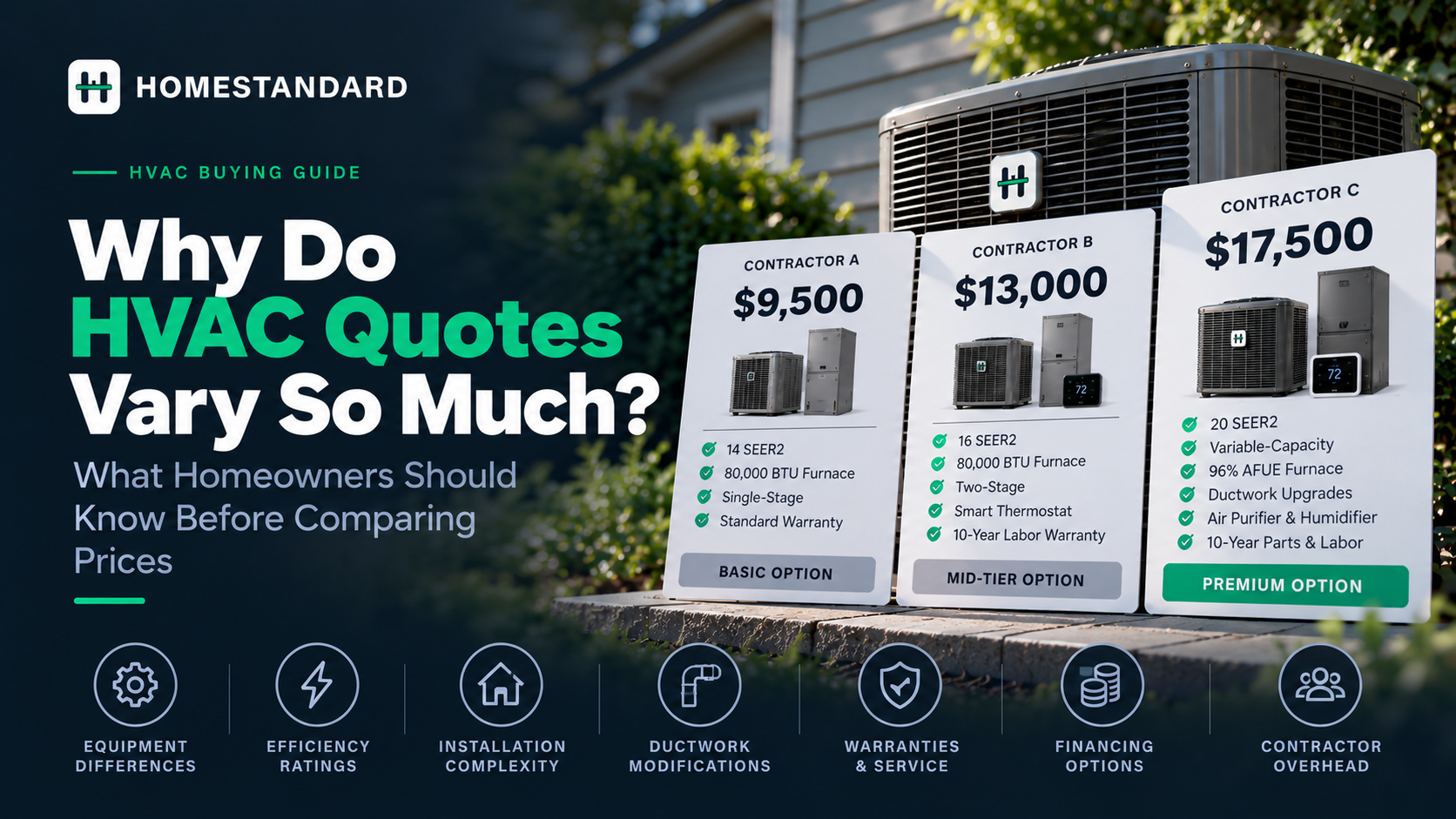
Why Do HVAC Quotes Vary So Much? What Homeowners Should Know Before Comparing Prices
You need a new HVAC system.
You call three contractors and get three quotes:
$9,500.
$13,000.
$17,500.
Same house. Same heating and cooling problem. Three dramatically different prices.
So what's going on?
Is the $9,500 contractor cutting corners? Is the $17,500 contractor overpriced? Or are you actually being quoted three completely different HVAC systems?
The frustrating answer is:
You can't tell from the price alone.
HVAC replacement isn't like buying a television where you can search the exact model number and compare prices between retailers. You're purchasing equipment and the design, installation, modifications, warranties, labor, and service that come with it.
Understanding those differences can make comparing HVAC quotes much easier.
Here's what you should look for before deciding which proposal actually provides the best fit for your home.
Why Can Two HVAC Quotes Be Thousands of Dollars Apart?
An HVAC replacement quote generally includes much more than the furnace or air conditioner itself.
The final price can be influenced by:
Equipment size
Efficiency
Compressor technology
Furnace type
Brand and equipment tier
Installation difficulty
Ductwork modifications
Electrical work
Refrigerant-line work
Venting
Controls and thermostats
Indoor air-quality accessories
Permits
Warranties
Financing
Labor
Contractor overhead
Two contractors can therefore look at the same house and propose systems with substantially different scopes of work.
The first step in comparing quotes is figuring out whether you're actually comparing the same thing.
1. The Equipment May Be Completely Different
A quote that says:
"3-ton air conditioner and 80,000 BTU furnace"
doesn't tell you nearly enough.
Two systems with those basic specifications could differ substantially in efficiency, features, operation, and price.
One contractor may be quoting basic single-stage equipment.
Another may be proposing a two-stage system.
Another may recommend variable-capacity equipment with communicating controls.
All three systems may technically heat and cool the same house, but they aren't necessarily comparable products.
When comparing quotes, look beyond equipment capacity.
Ask for the:
Manufacturer
Model or product series
SEER2 rating
Furnace AFUE
Compressor type
Blower type
Heat-pump heating performance, if applicable
Controls or thermostat included
Without those details, it's difficult to understand what you're actually comparing.
2. Efficiency Can Affect the Price
Higher-efficiency HVAC equipment generally costs more.
An entry-level air conditioner may meet current minimum efficiency requirements, while another system could have a substantially higher SEER2 rating.
The higher-efficiency system may consume less electricity for the same cooling output under comparable conditions.
But that doesn't automatically make it the better financial choice.
If one quote costs $3,000 more because of an efficiency upgrade, ask:
How much is this expected to save me each year?
If the estimated savings are $150 annually, energy savings alone would take a long time to recover the additional investment.
If the upgrade also provides better humidity control, quieter operation, variable capacity, or other comfort improvements, those benefits may still matter to you.
The important thing is understanding why you're paying more.
3. Single-Stage, Two-Stage, and Variable Equipment Can Have Very Different Prices
Not all HVAC systems operate the same way.
Single-Stage
A single-stage system essentially operates at full capacity whenever it's running.
It's generally simpler and less expensive.
Two-Stage
Two-stage equipment can operate at a lower output during lighter heating or cooling conditions and increase capacity when needed.
This can improve temperature consistency and comfort.
Variable-Capacity
Variable systems can adjust output across a much broader operating range.
They may operate for longer periods at lower capacities instead of repeatedly cycling on and off.
This can improve:
Temperature consistency
Humidity control
Noise
Comfort
Efficiency
If one contractor quotes basic single-stage equipment and another quotes premium variable-capacity equipment, a substantial price difference shouldn't be surprising.
They're selling different systems.
4. One Contractor May Be Fixing Problems Another Contractor Ignored
This is one of the most important differences to look for.
Imagine your existing HVAC system has an undersized return duct.
Contractor A replaces the equipment and connects it to the existing ductwork.
Contractor B identifies the airflow problem and includes modifications to improve the return-air system.
Contractor B's quote might be $1,500 higher.
On paper, Contractor A appears cheaper.
But they're not proposing the same installation.
The same thing can happen with:
Supply ductwork
Return ducts
Equipment transitions
Drainage
Refrigerant lines
Gas piping
Venting
Electrical wiring
Equipment platforms
Filtration
A higher quote isn't automatically better.
But a lower quote isn't automatically the better deal either.
You need to understand what each contractor plans to do.
5. System Sizing May Be Different
Another contractor may recommend a different equipment size entirely.
Suppose your existing home has a 4-ton air conditioner.
One contractor quotes another 4-ton system because that's what's currently installed.
Another contractor performs a load calculation and determines that the home actually requires closer to 3 tons.
Who's correct?
You can't answer that by comparing prices.
HVAC equipment should ideally be selected based on the home's heating and cooling requirements rather than automatically copying the capacity of the old system.
Oversized equipment can create problems such as:
Short cycling
Poor humidity control
Increased equipment wear
Temperature swings
Undersized equipment may struggle during extreme weather.
If contractors recommend different capacities, ask each one how they determined the required system size.
6. Installation Difficulty Can Change the Price
Installing HVAC equipment in an open basement is different from installing it in a cramped attic.
Consider two homes.
Home A
The equipment is easily accessible in an unfinished basement.
Home B
The equipment is located in an attic with restricted access and limited working space.
Even if both homes use identical equipment, the second installation may require considerably more labor.
Other installation factors can include:
Equipment location
Accessibility
Finished spaces
Crane requirements
Refrigerant-line length
Condensate drainage
Gas-line modifications
Venting changes
Electrical work
That's another reason online equipment prices rarely tell you what a complete installation should cost.
7. Warranties May Be Very Different
A cheaper quote may come with:
10-year parts warranty + 1-year labor warranty
Another contractor might include:
10-year parts warranty + 10-year labor warranty
Those proposals don't carry the same long-term financial risk.
Parts warranties generally don't automatically cover the cost of diagnosing the problem, removing the failed component, installing the replacement, refrigerant, or other labor-related expenses.
Ask exactly what each warranty covers.
Pay particular attention to:
Parts coverage
Labor coverage
Compressor coverage
Heat exchanger coverage
Warranty registration requirements
Maintenance requirements
Transferability
Exclusions
A warranty shouldn't automatically determine which system you choose, but it belongs in the comparison.
8. One Quote May Include Accessories the Other Doesn't
HVAC proposals often include additional products such as:
Smart thermostats
Media filters
Humidifiers
Dehumidifiers
UV lights
Air cleaners
Surge protection
Zoning systems
Equipment monitoring
These additions can increase the quote substantially.
Some may solve a real problem in your home.
Others may simply be optional upgrades.
Ask contractors to separate:
Required work
from
Optional upgrades.
That makes it much easier to understand the true cost of the core HVAC replacement.
9. Financing Can Make Quotes Harder to Compare
This is an area homeowners frequently overlook.
Suppose one contractor quotes:
$12,000 cash
Another offers:
$199 per month
The monthly payment sounds easier to evaluate, but it doesn't tell you what the system actually costs.
Financing can include:
Interest
Dealer fees
Promotional financing costs
Deferred-interest terms
Longer loan periods
In some cases, the contractor may pay a fee to the financing provider to offer certain promotional financing programs.
That cost may be reflected in the selling price.
Whenever possible, ask for:
Cash price + financing terms + total amount paid
Then compare the numbers.
10. Contractor Overhead Varies
HVAC companies aren't all structured the same way.
One contractor might be a small owner-operated business with a few trucks.
Another might employ hundreds of people and operate:
A large call center
Warehouses
Sales teams
Training departments
Dispatchers
Managers
Marketing departments
Fleet vehicles
24-hour service operations
Those businesses have very different overhead structures.
That overhead ultimately has to be reflected somewhere in the price of their services.
That doesn't automatically make a larger company overpriced.
The additional infrastructure may provide benefits such as scheduling capacity, extended service hours, training, warranty support, or faster response times.
Likewise, a smaller company may offer excellent workmanship with lower overhead.
Company size alone doesn't tell you whether the price is fair.
It simply helps explain why prices can differ.
11. The Cheapest Quote Isn't Necessarily a Bad Quote
It's easy to become suspicious when one contractor is dramatically cheaper.
Sometimes there's a legitimate reason.
The company may have:
Lower overhead
Different equipment purchasing agreements
Fewer sales and marketing expenses
Simpler operations
A different margin structure
A lower price does not automatically mean lower quality.
But you should understand what's included.
If the equipment, scope of work, warranty, installation process, and contractor qualifications are comparable, a lower price may genuinely represent better value.
The key word is comparable.
12. The Most Expensive Quote Isn't Necessarily the Best Either
The reverse is also true.
A $20,000 system isn't automatically better than a $12,000 system.
The higher quote may include legitimate improvements.
Or it may include features you don't need.
Or it may simply carry a higher markup.
Price alone isn't proof of quality.
Your goal isn't to find the cheapest contractor or the most expensive contractor.
It's to understand:
What am I getting for the additional money?
If the contractor can't explain that clearly, the higher price becomes difficult to justify.
How to Compare HVAC Quotes Side by Side
Instead of looking only at the bottom-line price, create an apples-to-apples comparison.
Category | Quote A | Quote B | Quote C |
|---|---|---|---|
Total price | |||
Equipment | |||
Capacity | |||
SEER2 | |||
Furnace AFUE | |||
Compressor type | |||
Blower type | |||
Duct modifications | |||
Electrical work | |||
Thermostat | |||
Accessories | |||
Parts warranty | |||
Labor warranty | |||
Permits | |||
Financing terms |
Once everything is visible side by side, the differences often become much easier to understand.
Questions to Ask When One Quote Is Much Higher
If one contractor is significantly more expensive, don't immediately reject the quote.
Ask:
“What specifically is included in your proposal that explains the difference?”
A good contractor should be able to answer.
Maybe they're:
Rebuilding return ductwork
Upgrading electrical service
Installing better equipment
Including a longer labor warranty
Correcting venting
Performing additional commissioning
Including accessories
Or maybe there isn't a compelling difference.
Either way, now you have information you can actually use.
Questions to Ask When One Quote Is Much Lower
You should do the same thing with an unusually inexpensive quote.
Ask:
“Is there anything normally required for this installation that isn't included in this price?”
Confirm whether the proposal includes:
Permits
Removal of old equipment
Refrigerant
Electrical work
Drainage
Duct transitions
Thermostat
Startup and commissioning
Warranty registration
The goal isn't to catch the contractor doing something wrong.
It's simply to make sure you're comparing complete prices.
Should You Get Three HVAC Quotes?
Getting multiple quotes can be useful, particularly for a planned replacement.
But three prices aren't automatically more informative than one.
If you don't understand what each contractor is proposing, you may simply end up with three numbers and more confusion.
The purpose of getting multiple quotes should be to understand your options, not just find the lowest bidder.
You may discover that contractors disagree about:
Equipment size
Ductwork
System type
Efficiency
Necessary modifications
Those disagreements are worth understanding before you make a decision.
Don't Let the Kitchen Table Be the First Time You See the Numbers
There's another challenge with HVAC replacement.
Most homeowners don't research HVAC systems until something breaks.
Then a salesperson is sitting at the kitchen table showing them options that might cost $10,000, $15,000, or $20,000.
You're trying to understand unfamiliar equipment, financing, efficiency ratings, warranties, and installation recommendations while your house may already be uncomfortable.
That's not an ideal environment for making a major financial decision.
The more you understand before the appointment, the easier it becomes to evaluate what you're being told.
Establish a Baseline Before You Compare Quotes
Before meeting with contractors, it helps to have an independent baseline.
You should have some understanding of:
Whether your current system is actually approaching replacement
What replacement could reasonably cost
What efficiency upgrades may be worth considering
Whether incentives may be available
What questions to ask
Which factors could materially change your price
Then when you receive a $9,500 quote and a $17,500 quote, you're not starting from zero.
You can start asking:
Why?
And that's ultimately the most important question when comparing HVAC proposals.
Know What the Numbers Say Before You Buy
A large difference between HVAC quotes doesn't automatically mean someone is ripping you off.
It also doesn't mean every price is reasonable.
It means you need enough information to understand what you're actually being quoted.
Home Standard helps homeowners establish that baseline before sitting down with a contractor.
Get a personalized analysis of your existing system, replacement readiness, expected replacement cost range, repair economics, efficiency opportunities, potential incentives, and other factors worth considering.
Free. About two minutes. No obligation.
Before you compare contractors, compare the numbers.
Keep reading
- HVAC Costs
How much does HVAC replacement cost?
What goes into a replacement price, and why ranges are more honest than single numbers.
Read - Repair vs. Replace
Should I repair or replace my HVAC system?
Age alone does not decide it. How repair cost, recurring issues, and comfort fit together.
Read - Heat Pumps
Heat pump vs. furnace
Climate, fuel costs, and existing equipment shape which system makes sense.
Read