Heat Pumps
Heat pump vs. furnace
Climate, fuel costs, and existing equipment shape which system makes sense.
By Home Standard9 min read
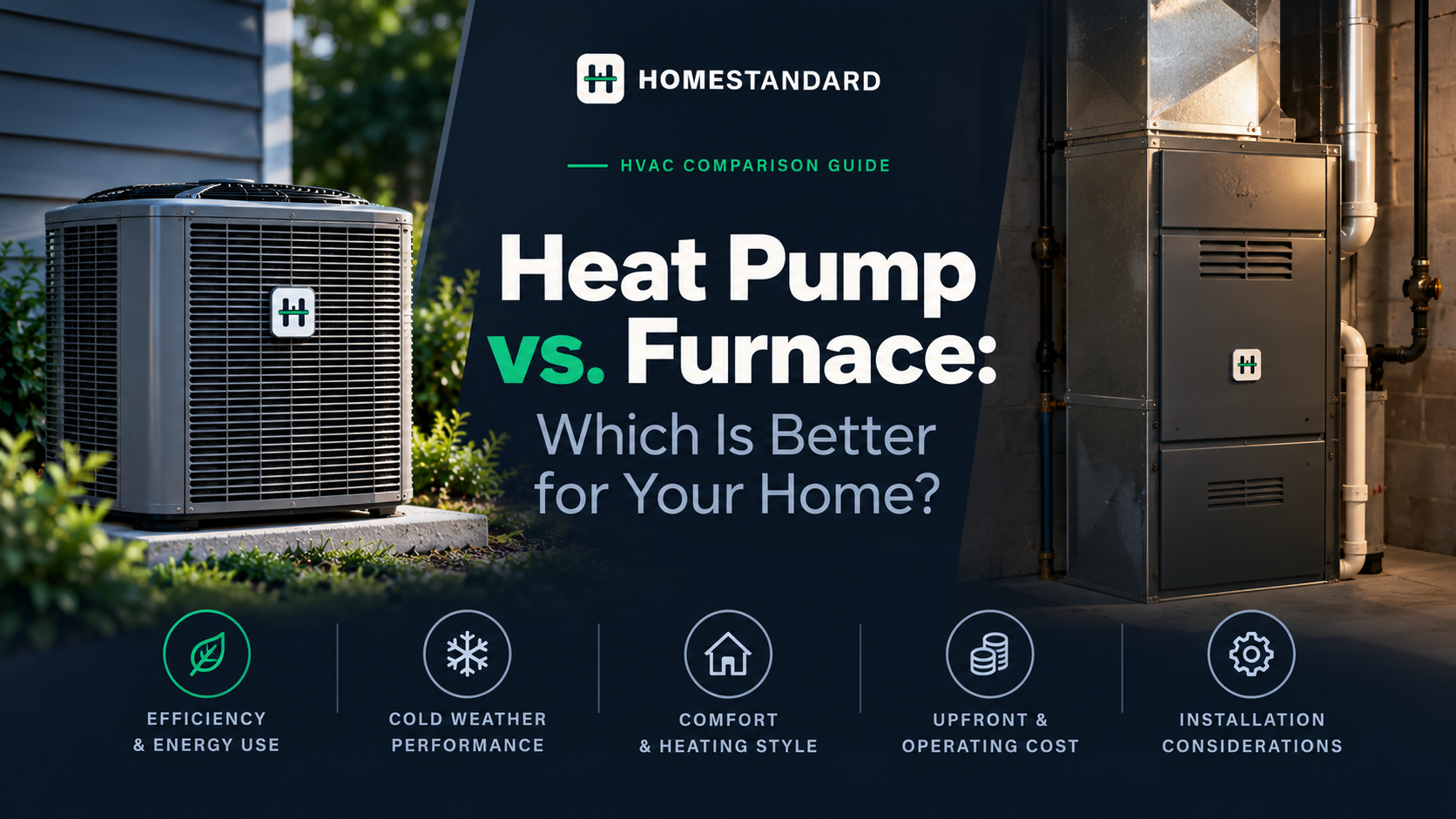
Heat Pump vs. Furnace: Which Is Better for Your Home?
If you're replacing your heating and cooling system, there's a good chance you'll eventually face this question:
Should I install a heat pump or stick with a furnace?
A few years ago, the answer was relatively straightforward in many colder parts of the country. Furnaces were the standard choice, while heat pumps were more commonly associated with warmer climates.
That's changing.
Modern heat pumps can operate effectively at much lower outdoor temperatures than older systems, giving homeowners another option for heating their homes. At the same time, gas furnaces remain extremely common and can provide powerful, reliable heat during cold weather.
So which one makes more sense?
The answer depends on your climate, utility rates, existing equipment, home, comfort preferences, and what you're trying to accomplish with your replacement.
Here's what you should know before deciding.
What's the Difference Between a Heat Pump and a Furnace?
The biggest difference is how they create heat.
A furnace generates heat. A gas furnace burns natural gas or propane and transfers that heat into the air circulating through your home. Electric furnaces use electric resistance heating instead.
A heat pump works differently.
Instead of generating most of its heat directly, it uses a refrigeration cycle to move heat from one place to another.
During the summer, a heat pump operates much like a conventional air conditioner, moving heat from inside your home to the outdoors.
During the winter, that process reverses. The heat pump extracts available heat from the outdoor air and transfers it into your home.
Yes, outdoor air can still contain usable thermal energy even when it feels very cold outside.
That one difference creates most of the advantages and disadvantages between the two systems.
Heat Pump vs. Furnace at a Glance
Heat Pump | Furnace | |
|---|---|---|
Heating method | Transfers heat | Generates heat |
Energy source | Electricity | Usually natural gas, propane, or electricity |
Provides cooling | Yes | No |
Requires separate AC | No | Usually |
Heating efficiency | Can be highly efficient | Depends on furnace efficiency |
Cold-weather performance | Depends on equipment and conditions | Strong |
Supply-air temperature | Generally lower | Generally hotter |
Eliminates combustion | Yes | Not with gas/propane |
Backup heat | Sometimes recommended | Usually unnecessary |
Neither technology is automatically better. They solve the same problem in different ways.
How Does a Heat Pump Work in the Winter?
This is where homeowners are often skeptical.
If it's 25°F outside, where exactly is the heat pump finding heat?
Even cold outdoor air contains thermal energy. Refrigerant circulating through the outdoor coil absorbs some of that energy.
The compressor then raises the refrigerant's pressure and temperature, allowing that heat to be released inside the home.
As outdoor temperatures fall, however, there is less heat available and the system generally has to work harder.
Older heat pumps could struggle significantly during cold weather.
Modern cold-climate heat pumps have improved substantially and can continue operating at temperatures well below freezing, although their capacity and efficiency depend heavily on the specific equipment.
That's why simply asking whether "heat pumps work in cold climates" doesn't tell you enough.
The better question is:
How much heating capacity does this particular heat pump maintain at the temperatures my home actually experiences?
Why Would I Choose a Heat Pump?
One of the biggest advantages of a heat pump is that one system can provide both heating and cooling.
A traditional gas HVAC setup typically consists of:
Air conditioner + furnace
A heat pump system may instead use:
Heat pump + air handler
That can eliminate the need for a gas furnace entirely.
Heat Pumps Can Be Very Efficient
Electric resistance heating essentially converts electricity directly into heat.
A heat pump is different because it's moving existing heat.
Under favorable conditions, that allows a heat pump to deliver significantly more heat energy than the electrical energy it consumes.
That can make heat pumps an efficient heating option, particularly during moderate winter temperatures.
But efficiency doesn't automatically equal lower utility bills.
We'll come back to that.
Why Would I Choose a Furnace?
Furnaces have a major advantage:
They can produce a lot of heat regardless of how cold it is outside.
A properly sized gas furnace doesn't depend on extracting heat from outdoor air.
That can make furnaces attractive in climates that experience very cold winter temperatures.
Gas furnaces also typically deliver hotter supply air than heat pumps.
That difference can affect how the home feels.
A heat pump may maintain a 70°F indoor temperature while producing longer periods of moderately warm airflow.
A furnace may deliver noticeably hotter air in shorter heating cycles.
Neither is inherently more comfortable, but homeowners accustomed to gas heat sometimes notice the difference.
Which Costs Less to Operate?
This is one of the most important questions — and one of the easiest to oversimplify.
You may hear:
"Heat pumps are more efficient, so they're always cheaper."
Or:
"Natural gas is cheaper, so furnaces always cost less."
Neither statement is universally true.
Your actual heating cost depends on several variables:
Electricity rates
Natural gas or propane prices
Outdoor temperatures
Heat-pump efficiency
Furnace efficiency
Home heat loss
Equipment sizing
Thermostat settings
Backup heat usage
A high-efficiency heat pump in a moderate climate with favorable electricity rates could be inexpensive to operate.
The economics may look different in a very cold climate with expensive electricity and inexpensive natural gas.
That's why operating-cost comparisons should use local utility rates and your home's actual heating requirements, rather than national averages.
What Happens When It Gets Extremely Cold?
Heat-pump performance changes as outdoor temperatures fall.
At some point, your home may require more heat than the heat pump can provide by itself.
This is sometimes described using the system's balance point.
Below that point, supplemental heat may be needed.
There are two common approaches.
Electric Auxiliary Heat
An all-electric heat-pump system may include electric resistance heat strips.
These can provide additional heating capacity during extreme weather.
The downside is that resistance heat generally consumes considerably more electricity than normal heat-pump operation.
Heavy auxiliary-heat usage can therefore increase winter electricity bills.
Dual-Fuel Heating
There's another option that combines both technologies.
A dual-fuel system typically uses:
Heat pump + gas furnace
During milder weather, the heat pump handles the heating.
When temperatures fall far enough that using the furnace becomes more appropriate, the system switches to gas heat.
For homeowners in climates with both moderate and very cold winter conditions, this arrangement can provide another way to balance efficiency, operating costs, and cold-weather capacity.
Does a Heat Pump Replace My Air Conditioner?
Usually, yes.
This is an important distinction when comparing prices.
A furnace only provides heating.
If you want central air conditioning, you typically need:
Furnace + air conditioner
A heat pump provides:
Heating + air conditioning
So comparing the price of a heat pump against the price of a furnace alone isn't necessarily an apples-to-apples comparison.
If you're replacing your entire HVAC system, compare the complete installed systems.
Which System Lasts Longer?
There isn't a guaranteed lifespan for either system.
Maintenance, installation quality, equipment design, climate, operating hours, and usage all matter.
However, there's one practical difference worth considering.
A furnace may operate primarily during the heating season while a separate air conditioner operates during summer.
A heat pump can operate during both heating and cooling seasons.
That means some heat-pump components may accumulate more annual operating hours.
This doesn't automatically mean a heat pump will fail early, but equipment utilization should be considered when evaluating long-term ownership costs.
What About Maintenance?
Both systems require maintenance.
A furnace may require inspection of components related to combustion, venting, burners, ignition, airflow, and safety controls.
A heat pump requires attention to refrigerant components, coils, electrical systems, airflow, controls, and the reversing system that allows it to switch between heating and cooling.
Heat pumps also periodically enter defrost mode during cold weather to remove frost from the outdoor coil.
Seeing steam or temporarily different operation during a defrost cycle can be normal and doesn't necessarily indicate a problem.
Regardless of which technology you choose, maintenance and installation quality can significantly affect reliability.
What About Safety?
Heat pumps don't burn fuel inside the home.
That means an all-electric heat-pump system eliminates combustion-related concerns associated with gas or propane heating equipment.
Gas furnaces, however, are designed with multiple safety controls and are widely used.
They require proper installation, venting, maintenance, and combustion safety practices.
Homes with fuel-burning appliances should also have properly installed and functioning carbon-monoxide detectors.
Safety shouldn't necessarily be viewed as "heat pump good, furnace bad."
Instead, understand what type of system you're installing and what proper operation and maintenance require.
Which Is Better for the Environment?
This answer also depends on context.
A heat pump doesn't produce combustion emissions at your home, but the electricity powering it has to come from somewhere.
The emissions associated with electricity vary depending on the local power grid and generation sources.
However, because heat pumps can move multiple units of heat for each unit of electricity consumed, electrification can potentially reduce overall energy use and emissions in many situations.
The exact environmental benefit depends on equipment efficiency, climate, grid generation, and what heating system is being replaced.
Can I Keep My Furnace and Add a Heat Pump?
Potentially.
If you currently have a gas furnace and central air conditioner, replacing the air conditioner with a compatible heat pump may allow you to create a dual-fuel system.
The heat pump can provide cooling during summer and heating during milder winter weather.
The furnace can provide heating when conditions call for it.
Compatibility matters, though.
Your contractor should evaluate the indoor coil, furnace, controls, electrical service, ductwork, and proposed outdoor equipment before recommending this configuration.
Don't Forget About Your Electrical System
Switching from gas heating to an all-electric heat-pump system can change your home's electrical requirements.
Depending on the equipment and backup heating configuration, you may need:
New electrical circuits
Larger breakers
Wiring modifications
Electrical-panel work
Additional capacity for auxiliary heat
These costs can materially affect the economics of switching systems.
They should be identified before you compare replacement options.
Your Ductwork Matters Too
A heat pump or furnace can only perform as well as the system distributing the air.
Problems such as:
Undersized return ducts
Restricted supply ducts
Excessive static pressure
Leaky ductwork
Poorly designed transitions
Inadequate airflow to certain rooms
can create comfort and efficiency problems regardless of which heating technology you purchase.
If you're replacing your HVAC system because certain rooms have always been uncomfortable, don't assume new equipment alone will solve the problem.
The duct system should be evaluated too.
Heat Pump vs. Furnace: What About Upfront Cost?
There isn't one universal answer.
Equipment costs vary considerably based on:
System capacity
Efficiency
Equipment type
Single-stage vs. variable-capacity operation
Brand
Installation difficulty
Electrical requirements
Duct modifications
Controls
Backup heat
Local labor costs
A basic furnace installation may cost less than a premium cold-climate heat-pump installation.
But that's not necessarily the correct comparison.
If the heat pump replaces both your furnace and air conditioner, you should compare the cost of the complete alternatives.
For example:
Option A: New furnace + new air conditioner
versus
Option B: New heat pump + air handler
versus
Option C: New heat pump + furnace dual-fuel system
That's a much more useful comparison.
Are There Rebates or Tax Incentives for Heat Pumps?
Heat pumps may qualify for utility, manufacturer, state, local, or federal energy-efficiency programs depending on when and where they're installed.
But incentives change.
Eligibility can also depend on the exact equipment, efficiency rating, installation, household circumstances, and program requirements.
Don't assume an advertised rebate automatically applies to your project.
Before making a purchasing decision based on an incentive, verify:
That the program is currently available.
That your specific equipment qualifies.
That you meet any homeowner or household requirements.
How and when the incentive is actually received.
An incentive can improve the economics of a heat pump, but it should be based on a program you can actually use.
Heat Pump vs. Furnace: Which One Makes Sense?
Here's a simple way to think about the differences:
Consideration | Heat Pump | Furnace |
|---|---|---|
Heating + cooling from one system | ✓ | Requires separate AC |
No combustion in the home | ✓ | Gas models use combustion |
Efficient moderate-weather heating | Strong advantage | Depends on fuel and efficiency |
Very cold weather capacity | Equipment-dependent | Strong |
Hotter supply air | Lower | Higher |
All-electric home | Excellent fit | Electric furnace possible |
Existing natural gas infrastructure | Still possible | Natural fit |
Dual-fuel option | Can pair with furnace | Can pair with heat pump |
But this table still doesn't tell you what you should buy.
That's because the right comparison requires information about your actual home.
Don't Choose Based on Equipment Type Alone
The biggest mistake is turning this into:
Heat pump vs. furnace — which technology wins?
That's not really the decision you're making.
You're deciding which complete HVAC system makes the most sense for your house.
That requires looking at:
Upfront cost + operating cost + comfort + climate + existing infrastructure + efficiency + installation requirements + expected ownership period.
A heat pump that looks more expensive initially could potentially reduce operating costs.
A furnace that appears less efficient on paper could potentially be inexpensive to operate where natural gas prices are favorable.
A dual-fuel system could make sense in another situation.
And poor installation can undermine any of them.
Questions to Ask Before Choosing
Before deciding between a heat pump and furnace, you should be able to answer:
What is my home's heating load?
What are my local electricity and fuel rates?
How does the proposed heat pump perform at low temperatures?
Will supplemental heat be required?
What will that supplemental heat cost to operate?
Does my electrical system need upgrades?
Is my existing ductwork adequate?
What are the complete installed prices?
What incentives actually apply?
What warranties are included?
If a contractor can't explain those differences clearly, you probably don't have enough information to make a meaningful comparison yet.
Know What the Numbers Say Before You Replace Your HVAC System
There's no universal winner in the heat pump vs. furnace debate.
A heat pump can provide efficient heating and cooling from a single system. A furnace can provide powerful heating regardless of outdoor temperature. A dual-fuel system can combine characteristics of both.
What matters is how those options perform in your home, in your climate, at your utility rates, and at the prices you've actually been quoted.
That's where Home Standard can help.
Before you spend $10,000+ on a new HVAC system, get a personalized analysis of your current equipment, replacement readiness, expected replacement cost, repair economics, efficiency opportunities, potential incentives, and the factors worth discussing with a contractor.
Free. About two minutes. No obligation.
Know what the numbers say before you make the decision.
Keep reading
- Repair vs. Replace
Should I repair or replace my HVAC system?
Age alone does not decide it. How repair cost, recurring issues, and comfort fit together.
Read - HVAC Costs
How much does HVAC replacement cost?
What goes into a replacement price, and why ranges are more honest than single numbers.
Read - HVAC Costs
Why HVAC quotes vary so much
Capacity, efficiency, ductwork, electrical, and access can move a price by thousands.
Read