Energy Savings
What SEER2 means
A plain-language guide to the efficiency rating on every new cooling system.
By Home Standard8 min read
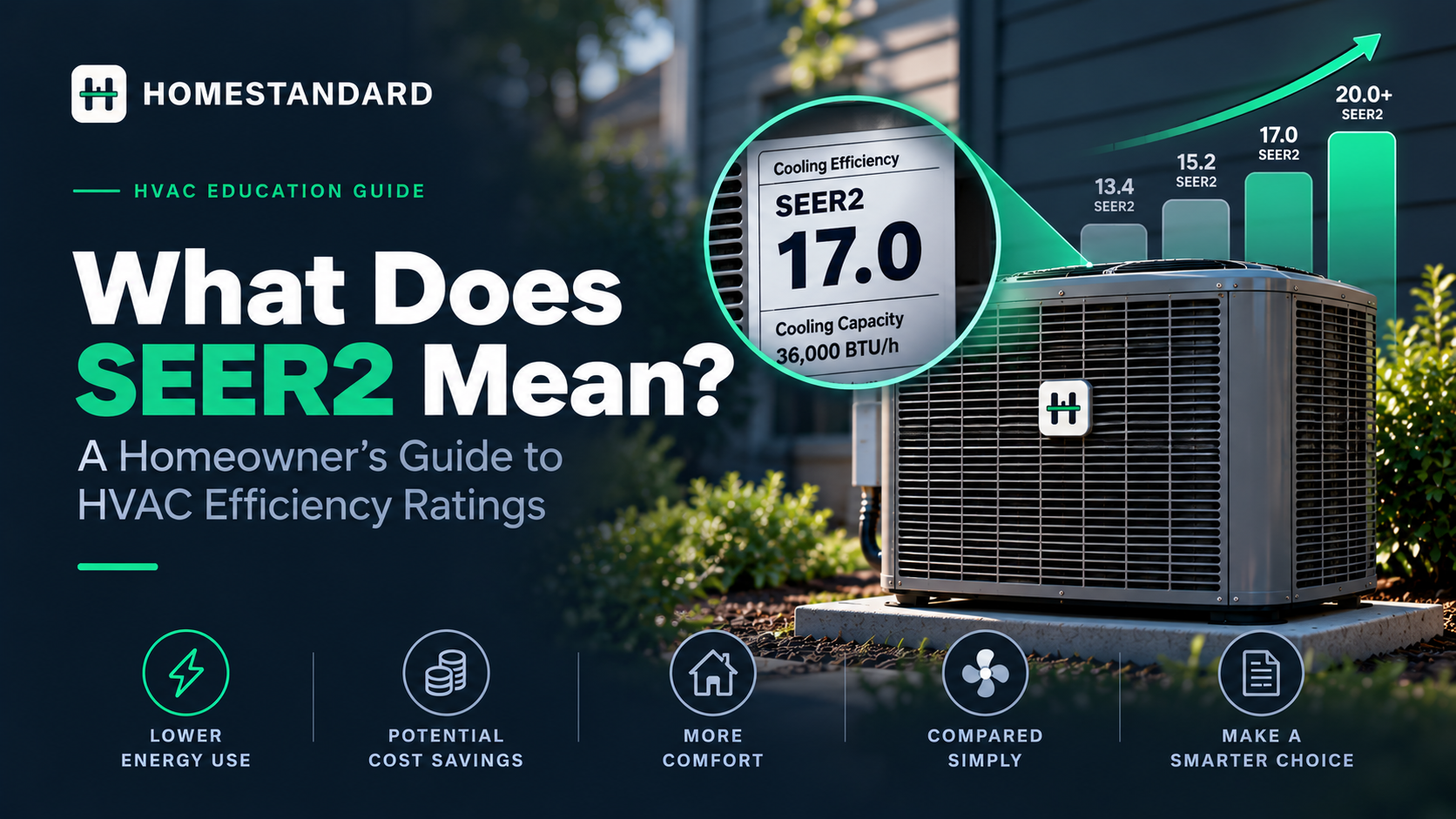
What Does SEER2 Mean? A Homeowner’s Guide to HVAC Efficiency Ratings
If you’re shopping for a new air conditioner or heat pump, you’re going to see numbers like:
13.4 SEER2
15.2 SEER2
17 SEER2
20+ SEER2
And if you’re like most homeowners, those numbers probably don’t mean much on their own.
HVAC contractors often talk about SEER2 as if a higher number automatically means a better system. While higher SEER2 ratings do indicate greater cooling efficiency under standardized testing conditions, that doesn’t necessarily mean buying the highest-rated equipment will save you the most money.
So before you spend thousands more upgrading to a higher-efficiency system, it helps to understand what you’re actually buying.
Here’s what SEER2 means, how it affects your energy usage, and when paying for a higher rating may — or may not — make financial sense.
What Does SEER2 Stand For?
SEER2 stands for Seasonal Energy Efficiency Ratio 2.
It’s an efficiency rating used for air conditioners and heat pumps.
In simple terms, SEER2 compares the amount of cooling a system provides over a simulated cooling season with the amount of electricity it uses to provide that cooling.
The higher the SEER2 rating, the more efficiently the equipment can provide cooling under the test procedure.
Think about it somewhat like MPG for a car.
Two cars can both get you to the same destination, but one might use less fuel to do it.
Similarly, two air conditioners can both cool your home, but the higher-efficiency system may require less electricity to provide the same amount of cooling.
However, just like a car’s advertised fuel economy doesn’t perfectly predict what every driver will experience, a SEER2 rating doesn’t tell you exactly what your utility bill will be.
Why Is It Called SEER2 Instead of SEER?
If you’ve owned HVAC equipment for a while, you may be more familiar with SEER.
SEER2 is the newer testing standard.
The U.S. Department of Energy introduced updated efficiency requirements and testing procedures that took effect in 2023.
One of the important changes was an updated test procedure intended to better represent the external static pressure HVAC equipment encounters when installed in an actual duct system.
That’s why you shouldn’t directly compare a SEER rating on older equipment with a SEER2 rating on newer equipment as though the numbers were measured identically.
They’re related efficiency metrics, but the testing procedures are different.
How Is SEER2 Calculated?
At a high level, the rating compares:
Total seasonal cooling output ÷ total electrical energy consumed
The result is the system’s SEER2 rating.
You don’t need to calculate this yourself when buying equipment. Manufacturers test and rate qualifying combinations of indoor and outdoor equipment.
What matters for a homeowner is the relationship:
Higher SEER2 = less electricity required to produce a given amount of seasonal cooling under the rating conditions.
For example, a 17 SEER2 system is more efficient than a 14 SEER2 system under standardized testing.
But that does not mean the 17 SEER2 system will automatically reduce your entire electric bill by roughly 18%.
Your air conditioner is only one part of your electricity consumption, and real-world performance depends on much more than the equipment’s laboratory rating.
Is a Higher SEER2 Rating Always Better?
From a pure cooling-efficiency standpoint, higher is better.
From a financial standpoint, not necessarily.
Suppose you're comparing two replacement options.
One is a standard-efficiency system.
The other has a considerably higher SEER2 rating but costs several thousand dollars more.
The higher-efficiency equipment should consume less electricity for the same cooling output, but the important question is:
How much less?
If the upgrade saves you $200 per year but costs an additional $4,000, it would take roughly 20 years of those savings to recover the additional upfront investment, ignoring changes in energy prices, maintenance, financing, and other factors.
On the other hand, if your home has a long cooling season, expensive electricity, and high annual cooling usage, the savings from increased efficiency could be much more meaningful.
That's why the highest SEER2 number isn't automatically the best investment.
How Much Can a Higher SEER2 Rating Save?
You can make a rough comparison between two efficiency ratings using this relationship:
1 − (lower SEER2 ÷ higher SEER2)
For example, compare a 14 SEER2 system with an 18 SEER2 system:
14 ÷ 18 = 0.778
1 − 0.778 = 0.222
That means the 18 SEER2 system could theoretically use about 22% less electricity for the same amount of cooling under comparable conditions.
But there's an important distinction:
That's approximately 22% of the cooling energy consumption, not 22% of your entire electric bill.
If cooling accounts for $800 of your annual electricity spending, the theoretical difference would be much smaller in dollars than if you're spending $2,000 per year on cooling.
Your actual savings can also vary because of weather, thermostat settings, duct leakage, system sizing, maintenance, equipment staging, and installation quality.
SEER2 Doesn't Tell the Whole Story
One of the biggest mistakes homeowners can make is comparing HVAC systems using SEER2 alone.
Efficiency is important.
But so are:
Equipment sizing
Duct design
Airflow
Installation quality
Humidity control
Compressor technology
Blower performance
Controls
Reliability
Maintenance requirements
A properly installed lower-SEER2 system can potentially provide a better ownership experience than a premium system installed poorly.
The number on the equipment doesn't compensate for bad design or installation.
Single-Stage vs. Two-Stage vs. Variable-Capacity
Higher-efficiency equipment is often paired with more advanced compressor technology.
That can provide benefits beyond the SEER2 number itself.
Single-Stage
A single-stage air conditioner generally operates at full output whenever it runs.
It's either:
ON or OFF.
These systems tend to be simpler and less expensive.
Two-Stage
Two-stage equipment can operate at a lower output during lighter cooling conditions and increase capacity when more cooling is required.
Longer runtimes at lower capacity can potentially improve temperature consistency and humidity control.
Variable-Capacity
Variable-capacity equipment can adjust output across a broader range.
Instead of repeatedly cycling between zero and full capacity, the system can operate closer to the amount of cooling the home needs at a particular moment.
This can improve:
Temperature consistency
Humidity control
Noise levels
Comfort
Efficiency
So if you're comparing a basic 14 SEER2 system with a premium 20 SEER2 variable-capacity system, you're not necessarily paying only for an efficiency increase.
You may also be paying for a different comfort experience.
Your Ductwork Can Affect Real-World Efficiency
Imagine purchasing an expensive high-efficiency HVAC system and connecting it to ductwork that leaks conditioned air into an attic or crawlspace.
The equipment itself may be efficient.
The system as a whole isn't.
Problems such as:
Duct leakage
Undersized returns
Restricted airflow
Poorly designed transitions
Dirty filters
Improper blower settings
can affect how effectively your HVAC system operates.
That's one reason Home Standard focuses on evaluating the overall situation rather than simply telling homeowners to buy equipment with the highest efficiency rating.
System Sizing Matters Too
An oversized air conditioner may cool your home quickly, but that's not necessarily a good thing.
Cooling systems also help remove humidity.
If the equipment is significantly oversized, it may satisfy the thermostat quickly and shut off before operating long enough to effectively manage indoor humidity.
That can leave the house feeling cool but clammy.
It can also lead to frequent cycling.
An appropriately sized system may run for longer cycles while maintaining more consistent temperatures and humidity.
A proper HVAC replacement evaluation should therefore consider the home's heating and cooling requirements rather than automatically replacing the old equipment with the same nominal size.
What's a Good SEER2 Rating?
There isn't one SEER2 rating that's ideal for every homeowner.
A better question is:
Which efficiency level gives me the best combination of upfront cost, operating cost, comfort, and expected ownership period?
For one homeowner, a relatively basic system may make the most financial sense.
Another homeowner may benefit from investing in higher efficiency because they:
Live in a hot climate
Have high electricity rates
Run the air conditioner extensively
Plan to stay in the home for many years
Want better humidity control
Value quieter operation
Want variable-capacity equipment
The correct choice depends on what the upgrade costs and what you're getting in return.
What SEER2 Rating Is Required?
Minimum efficiency requirements for new HVAC equipment depend on factors including equipment type and applicable federal standards.
These requirements can change over time.
That means you shouldn't rely on an old article or assume that a particular rating is currently the minimum for every installation.
If you're replacing equipment, your contractor should be able to identify the applicable efficiency requirements for the specific equipment being installed.
More importantly, meeting the minimum requirement only tells you what can legally be installed.
It doesn't tell you which efficiency level makes the most sense financially for your home.
What About Heat Pumps?
Heat pumps use SEER2 for cooling efficiency too.
But because heat pumps also provide heating, SEER2 isn't the only efficiency rating you should evaluate.
You'll also encounter heating-performance metrics such as HSPF2.
That matters because a heat pump with impressive cooling efficiency isn't necessarily the best heating option for your specific climate.
If you're considering a heat pump, you should evaluate both its cooling and heating performance — particularly how its heating capacity and efficiency change as outdoor temperatures fall.
Does Higher SEER2 Increase Home Value?
You should be cautious about assuming an expensive HVAC efficiency upgrade will produce an equivalent increase in resale value.
Buyers may appreciate newer, efficient equipment, but there is no guarantee that spending several thousand dollars more on a premium SEER2 rating will increase your home's selling price by the same amount.
If you're planning to move soon, the financial calculation for an efficiency upgrade may therefore look different than it would for someone planning to stay in the home for 15 years.
Your expected ownership period matters.
How Should I Compare HVAC Efficiency Options?
If a contractor gives you three replacement options, don't just compare:
14 SEER2 vs. 16 SEER2 vs. 20 SEER2
Instead, compare the entire package.
Question | Why It Matters |
|---|---|
What is the installed price? | Determines your upfront investment |
What is the certified efficiency? | Shows rated performance |
Is it single-, two-, or variable-capacity? | Can affect comfort and operation |
What are the estimated energy savings? | Helps evaluate the upgrade |
What assumptions were used? | Determines whether savings estimates are realistic |
What warranty is included? | Affects ownership risk |
Does ductwork need modification? | Can affect actual performance |
How long will I own the home? | Affects potential payback |
This gives you a much better basis for making a decision than simply choosing the system with the biggest number.
Be Careful With Efficiency Savings Claims
If you're told:
“This system will cut your electric bill by 40%.”
Ask how that number was calculated.
Does it mean:
40% less cooling energy?
40% less total household electricity?
A laboratory efficiency comparison?
An estimate based on your actual utility bills?
Those are very different claims.
A meaningful savings estimate should consider your existing equipment, local climate, electricity rate, usage, and proposed replacement.
Otherwise, it's primarily a theoretical comparison.
The Real Question: Is the Efficiency Upgrade Worth It?
Suppose you're comparing:
System A: $11,000
System B: $14,000
System B is more efficient.
The question isn't simply whether System B uses less electricity.
It probably does.
The question is whether the additional $3,000 investment makes sense given the expected savings and other benefits.
If the upgrade also gives you variable-capacity operation, better humidity control, quieter performance, and a stronger warranty, you may value those benefits independently of energy savings.
That's perfectly reasonable.
But you should understand what you're paying for.
Know What the Numbers Say
SEER2 is useful.
It gives homeowners a standardized way to compare the cooling efficiency of HVAC equipment.
But it's only one number.
It doesn't tell you whether the system is sized correctly.
It doesn't tell you whether your ductwork is adequate.
It doesn't tell you what you'll actually spend on electricity.
And it doesn't tell you whether paying thousands more for a higher rating makes financial sense.
That's why Home Standard looks beyond the equipment label.
Before spending $10,000+ on a new HVAC system, understand your existing system, expected replacement cost, repair economics, efficiency opportunities, potential incentives, and the numbers behind the options you're considering.
Free. About two minutes. No obligation.
Know what the numbers say before you buy.
Keep reading
- Repair vs. Replace
Should I repair or replace my HVAC system?
Age alone does not decide it. How repair cost, recurring issues, and comfort fit together.
Read - HVAC Costs
How much does HVAC replacement cost?
What goes into a replacement price, and why ranges are more honest than single numbers.
Read - HVAC Costs
Why HVAC quotes vary so much
Capacity, efficiency, ductwork, electrical, and access can move a price by thousands.
Read